

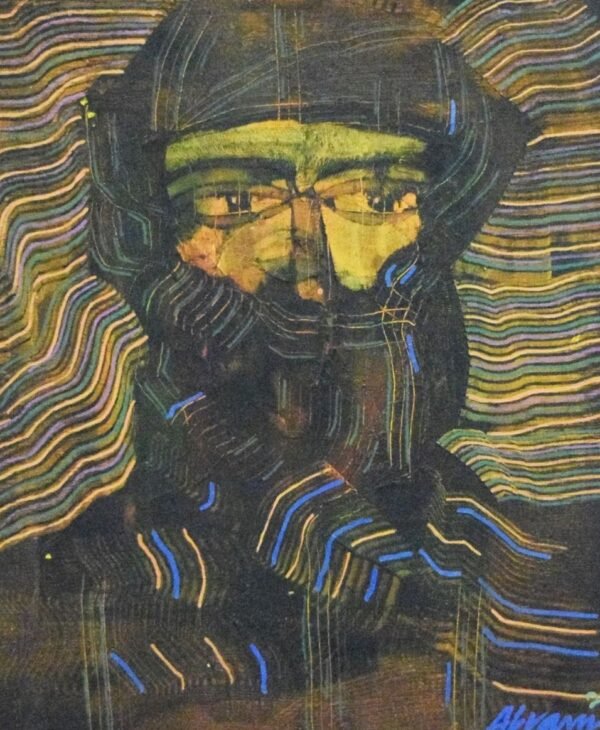
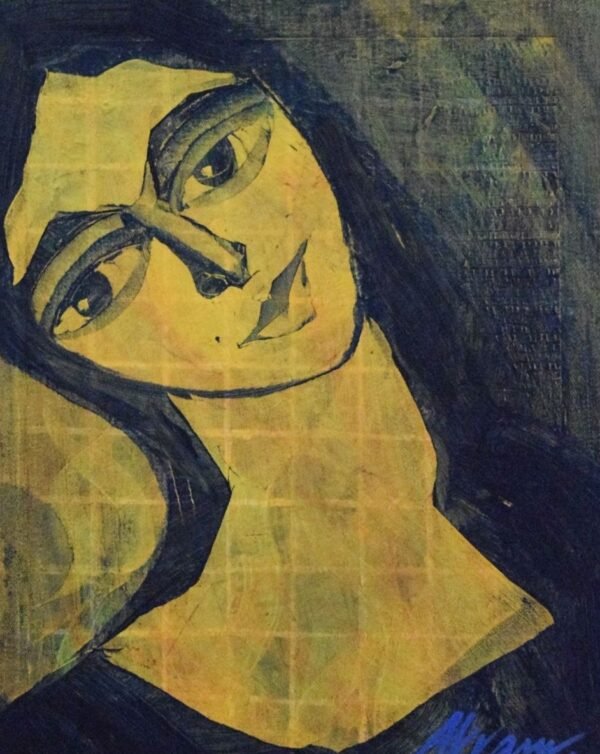
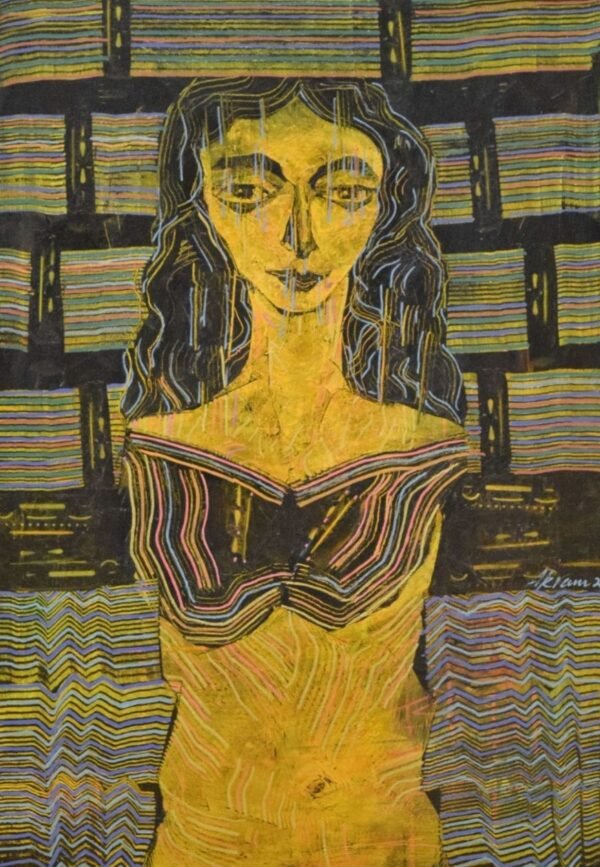
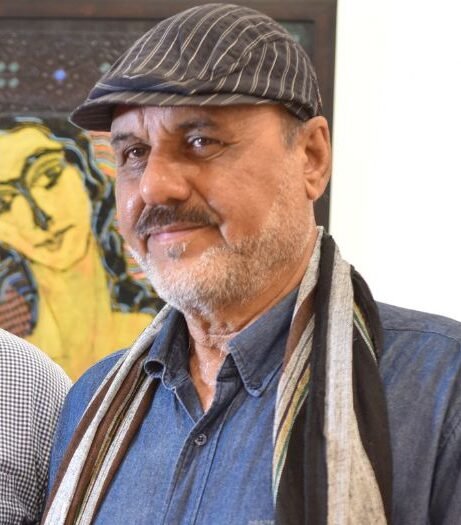
Hailing from Naushki Balochistan, Akram Dost Baloch graduated from National College of Arts, Lahore, and is among the founding faculty of the Department of Fine Arts, University of Balochistan. His aesthetics are inspired by the primordial motifs of embroidery, wood carving, and the craft of weaving from the region. Akram is a prolific artist always eager to reinvent and explore new dimensions in his expression while staying rooted. He has received wide acclaim, both at home and abroad and also received President’s Pride of Performance Award, Pakistan’s highest civilian award for excellence in 2004.
For Akram, it is important to keep the constant internal and individual process evolving as an artist. His source of inspiration has never been Picasso or Shakir Ali and Akram Dost does not shy away from admitting this. His inspiration is the order in the chaos he finds around him. “I by no means underestimate the value of a book or a whiteboard but my creative process is much more organic than to be dependent on tools or mediums. Growing up I saw indigenous aesthetics all around me. When I was in school, I used to go and spend time with the artisans from my area and get fascinated by how they dyed the wood, made threads, combined colours, and the folk songs they sang. That fascination has stayed with me ever since.”
Akram is proud of the fact that despite the widespread deprivation in Balochistan, there is no dearth of indigenous wisdom. “Today many may consider this politically incorrect but young girls who have finesse in their embroidery or a better sense of matching colours are considered most eligible for marriage in our rural communities. I see a kind of appreciation for artistic merit in this. Unfortunately, we either prefer to shun our indigenous art or focus on macrocosm heritage. We feel embarrassed of our roots in art, in culture, and in politics. Politics as well as art can drive a society towards sophistication. As far as art is concerned, most of the art that you see coming out of bigger cities and renowned art colleges of the country is very commercial. An artist compromising under the pressure to be commercially successful is a grave loss.” He opines.
For Akram it is not possible to detach himself from the political realities of his surroundings. “They have usurped the resources of our region and displayed large billboards to celebrate CPEC in Islamabad. They are actually afraid of us. If a torn jean is less unsettling than a tribesman’s moustache or his pagri then we don’t have to worry. We have nothing to fear from the people who don’t take pride in their own identity. Once Musharraf was visiting France and the French President asked him about updates on the archaeological discoveries of Mehrgarh. President Musharraf had no clue what Mehrgarh was and turned to his military secretary who of course also didn’t have a clue. The French President ended up tutoring Musharraf on the significance of Mehrgarh. Situations like these are very unfortunate.”
“I was recently curating an exhibition of artists from Balochistan in Karachi. I had also arranged for a panel discussion on these lines. During the discussion, they kept focusing on CPEC but I said my identity is Mehrgarh and not CPEC. CPEC may be China’s economic interest and there is nothing wrong with that; every nation has the right to pursue their economic interests. I cannot recite Faiz’s poetry and focus only on the beauty of his verses. We prefer to look at the obvious explanations. Truth is inconvenient. No one is a fool; no one wants to die or get killed. I belong to the area of Saindak and Riko Dek. While Benazir Bhutto was the Prime Minister and was visiting Balochistan to inaugurate a project in the region, I was requested to set up a commemorative…”